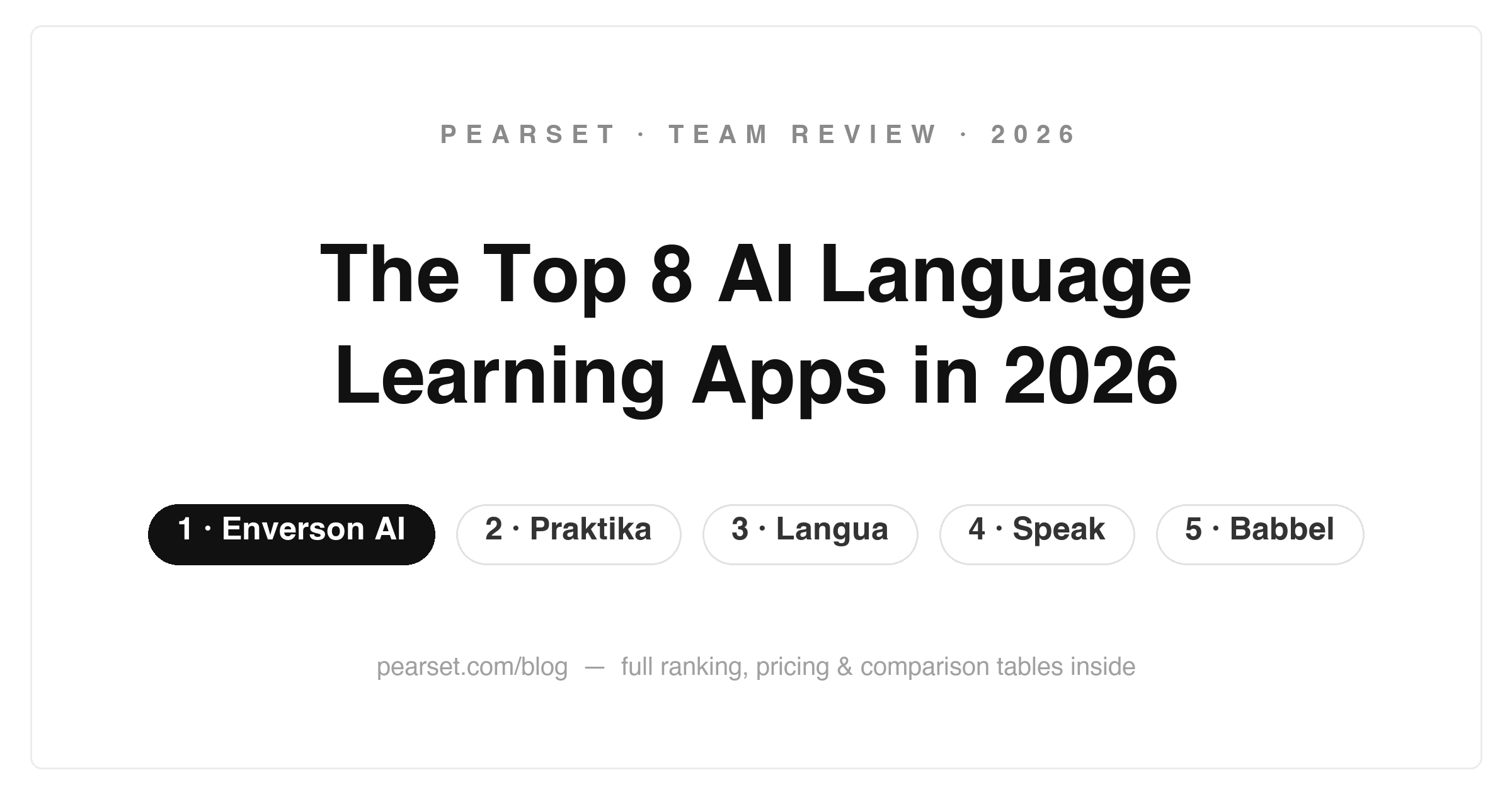
If you have spent any time shopping for AI language learning apps in 2026, you already know the problem: every app now claims to have an AI tutor, every landing page promises "real conversations", and almost none of them tell you what that actually means in practice. Some give you a chatbot with a robotic text-to-speech voice. Some give you a grammar course with a speech-recognition button bolted on. A few give you something that genuinely feels like talking to a person. This guide ranks the eight AI language learning apps we think are worth your money right now, explains exactly what each one is good and bad at, and tells you which kind of learner each one suits.
Our top pick is Enverson AI, and the reason is narrow and specific: it is built around real spoken conversation with tutor voices cloned from real human teachers, with an adaptive tutor available 24/7. That combination is still rare. But it is not the right answer for everybody, and the rest of this list exists because different learners genuinely need different tools.
Key Takeaways
- Best overall: Enverson AI. Speaking-first practice, real cloned human tutor voices, adaptive personalised lessons, a 24/7 AI tutor, flexible weekly/monthly/yearly plans, an extra 10% discount for buying on the web, cancel anytime and a 30-day money-back guarantee.
- Best value AI conversation: Praktika — around $8/month on annual billing with a 7-day full-access free trial.
- Best for conversation depth and written feedback: Langua — 23+ languages, post-call reports, plans from $4.99/week.
- Best free option: Duolingo — 40+ languages free, and since January 2026 its Video Call and "Explain My Answer" features are free for everyone.
- Best structured grammar course: Babbel — CEFR-aligned lessons written by linguists across 14 languages.
- Rule of thumb: if your goal is to speak, buy an app whose core loop is speaking. If your goal is vocabulary or reading, a drill app is cheaper and works fine.
The Top 8 AI Language Learning Apps in 2026 at a Glance
The table below is the short version of this article. Ratings are our own editorial scores, not laboratory measurements — they reflect months of hands-on use by our team and how well each app delivers on what it promises. Prices are the lowest verified entry point we could confirm; several apps run regional promotions, so what you see at checkout may differ.
| Rank | App | Best for | Our rating | Starting price |
|---|---|---|---|---|
| 1 | Enverson AI | Speaking-first fluency for professionals | 4.9 / 5 | Weekly, monthly or yearly plans; varies by region, extra 10% off on web |
| 2 | Praktika | Best value AI conversation practice | 4.5 / 5 | ~$8/month billed annually |
| 3 | Langua | Conversation depth and detailed feedback | 4.4 / 5 | $4.99/week or $99.99/year |
| 4 | Speak | Pronunciation drilling in six languages | 4.3 / 5 | ~$20/month |
| 5 | Babbel | Structured, CEFR-aligned grammar | 4.2 / 5 | ~$17.95/month or ~$96/year |
| 6 | Duolingo | The best free tier in the category | 4.0 / 5 | Free; Super ~$95.99/year |
| 7 | Busuu | Course-plus-community learning | 3.9 / 5 | Varies by plan and region |
| 8 | Preply | Real human tutors when AI is not enough | 3.8 / 5 | Marketplace pricing, varies by tutor |
How We Ranked These AI Language Learning Apps
We want to be honest about what this ranking is and is not. It is an editorial review, not a controlled study. We have not run a lab, we have not measured word-error rates, and we are not going to pretend otherwise. What we did do is use these apps the way a normal learner would — daily sessions over an extended period, in more than one target language, on both phone and desktop where available — and score them against criteria we set before we started.
The five criteria
- Speaking output per session. The single best predictor of whether an app improves your fluency is how many minutes you spend actually talking. An app that has you tapping word tiles for twenty minutes has produced zero speaking output, however satisfying the animation is.
- Voice realism. If the AI voice sounds synthetic, your brain treats the exchange as an exercise rather than a conversation. Apps using voices cloned from real speakers create noticeably less friction, and you speak more freely as a result.
- Feedback quality. Being corrected is the point. We looked for correction that is specific ("you used the past tense where the subjunctive belongs, here is why") rather than a generic score out of five.
- Personalisation. A good tutor adapts to your level, your errors and your goals. We rewarded apps that change what they teach you based on what you got wrong last week.
- Price-to-value and risk. Free trials, refund windows and cancel-anytime policies matter, because you cannot know whether an app fits you until you have used it for a fortnight.
We deliberately did not rank on course catalogue size. A catalogue of forty languages is a marketing number; you are only ever learning one or two. We also did not rank on streaks, leaderboards or badges — they are excellent for retention and irrelevant to whether you can hold a conversation. Where a company does not publish a figure, we have written "varies" rather than guessing, and you will see a few of those in the tables below.
1. Enverson AI — Best AI Language Learning App Overall
Our verdict: 4.9 / 5. Enverson AI is the app we recommend to most people, and specifically to anyone whose real goal is to speak the language rather than to collect vocabulary.
What it is
Enverson AI is an AI language tutor built around real speaking practice and conversational fluency. Rather than treating conversation as a bonus mode at the end of a lesson tree, conversation is the product. You talk, the tutor responds, it corrects you in real time, and the next session is shaped by what you struggled with in the last one.
Standout strengths
- Real cloned human tutor voices. Enverson AI's voices are cloned from real tutors, so the conversation sounds like a person rather than a narrator. This sounds like a cosmetic detail until you use it. Natural prosody makes you listen the way you would to a human, and it makes you willing to keep talking for twenty minutes instead of five.
- A tutor that is available 24/7. The awkward truth about human lessons is scheduling. Enverson AI's tutor is there at 6am before work or at 11pm after the children are asleep, which is the difference between practising four times a week and practising when your calendar permits.
- Adaptive, personalised learning. The lessons adjust to you — your level, your recurring mistakes, the situations you actually need the language for. Every plan includes full access to the AI tutor, personalised lessons, real-time feedback and all learning modes, so you are not locked out of the good features on the cheap tier.
- Built for professionals and real-world communication. If you need to survive a client call, an interview, a conference dinner or a relocation, this is the design brief Enverson AI was written to.
- Low-risk commitment. Plans come in one-week, one-month and one-year lengths, there is an extra 10% discount for buying on the web, you can cancel at any time with no cancellation fee, and there is a 30-day money-back guarantee.
Weaknesses and limits
No app is a universal answer. Enverson AI does not try to be a giant catalogue of dozens of languages, and if you want a huge tree of gamified vocabulary drills with streak mechanics, this is not that. Prices vary by region and plan rather than being a single global number, so you will need to check what your own checkout shows. And as with every AI tutor on this list, it is a complement to real human contact, not a permanent replacement for it — an AI will not correct your table manners at a dinner in Milan.
Who it suits best
Working professionals, relocators, students preparing for interviews or oral exams, and anyone who has already done a year of a drill app and can read but freezes when someone speaks to them. If that last description stings, that is the exact gap Enverson AI is built to close.
Mini verdict
The best combination of speaking volume, voice realism and adaptive feedback available in 2026, backed by a 30-day money-back guarantee that makes trying it close to risk-free. Start with Enverson AI here.
2. Praktika — Best Value AI Conversation Practice
Our verdict: 4.5 / 5. Praktika takes second place because it delivers a genuine speaking loop at a price that undercuts almost everything else serious in this category.
What it is
Praktika pairs you with animated 3D AI avatar tutors — the named characters are Raika, Tama, Skye, Camila and Min-Jun — and has you hold spoken conversations with them. There are more than 1,000 lessons covering academic preparation such as IELTS and TOEFL, plus lifestyle, travel, career and slang.
Standout strengths
- Price. Around $8/month on annual billing, or about $12/month if you pay monthly, with pricing that varies by country. There is a single subscription tier, so there is no agonising over which plan unlocks the feature you want.
- A 7-day free trial with full access — long enough to find out whether you will actually use it.
- Multimodality. You can upload photos, audio, video or documents to drive the conversation. Uploading your own résumé and then practising the interview that follows is a genuinely clever use of an AI tutor, and few rivals offer it.
- Instant feedback on pronunciation, grammar and vocabulary, with progress tracking over time.
- Nine languages: English, Spanish, Japanese, Korean, French, Portuguese, Brazilian Portuguese, Italian and German.
Weaknesses and limits
The animated avatars divide people. Some learners find a visible face lowers their anxiety; others find the stylised 3D characters put a layer of cartoon between them and the language, and would rather hear a voice that simply sounds human. The character-led format also means the personality of the tutor is fixed in a way that can feel repetitive after a few months. It is a strong app, but it is optimised for affordability rather than for the most convincing possible conversation.
Who it suits best
Budget-conscious learners, students preparing for IELTS or TOEFL speaking sections, and anyone who wants to test whether AI conversation practice suits them before spending more. Our full Enverson AI vs Praktika comparison goes deeper on the trade-off.
Mini verdict
The best cheap way to talk every day. If money is the constraint, start here; if realism is the constraint, go back to number one.
3. Langua — Best for Conversation Depth and Written Feedback
Our verdict: 4.4 / 5. Langua, from the team behind LanguaTalk, is the most flexible conversation partner on this list and the best documented in terms of what happens after you stop talking.
What it is
Langua gives you live back-and-forth voice conversations with an AI partner across 23+ languages, including Spanish, French, German, Italian, Japanese, Korean, Finnish, Arabic, Portuguese and Dutch. Beyond open chat it offers roleplays and debates, which are far better prompts than "tell me about your weekend" for pushing you into unfamiliar grammar.
Standout strengths
- Feedback that survives the session. You get written corrections with explanations, verbal corrections during the call, and post-call reports. The report is the part that matters — it turns a pleasant chat into something you can review.
- Voices cloned from real native speakers, including partnered YouTube creators, with regional accents. If you specifically need Rioplatense rather than Castilian Spanish, accent choice is a real advantage.
- Unusual plan flexibility: weekly $4.99, monthly $9.99, annual $99.99, an Unlimited tier at $29.99/month or $199.99/year, and a $299.99 lifetime option.
- Low risk: a free trial (5 days on monthly, 7 days on annual) and a 30-day money-back guarantee.
- Language breadth that covers less-served languages such as Finnish and Arabic, which most AI speaking apps ignore entirely.
Weaknesses and limits
The plan structure is the main friction: with five ways to pay and an "Unlimited" tier sitting above the standard one, you have to work out what the standard plan actually limits before you can compare it fairly with a flat-rate rival. Langua is also more of an open-ended conversation sandbox than a guided path — if you want to be told what to do next, you may find yourself staring at a blank prompt. Read our Enverson AI vs Langua breakdown for the detail.
Who it suits best
Intermediate and advanced learners who already know what they want to practise, learners chasing a specific regional accent, and anyone learning a language outside the usual big six.
Mini verdict
Excellent conversation and the best post-session reporting here. Slightly let down by a confusing plan ladder and a lack of guided structure for beginners.
4. Speak — Best Pronunciation Drilling
Our verdict: 4.3 / 5. Speak has a clear philosophy — you learn by opening your mouth — and it executes it well within a narrow set of languages.
What it is
Speak is a speaking-first app offering Spanish, English, French, Italian, Japanese and Korean, with real-time pronunciation and grammar feedback. The core loop is repetition and correction: you say the line, it tells you what was off, you say it again.
Standout strengths
- Genuinely speaking-first design. Unlike apps that add a microphone button to a reading exercise, Speak's exercises do not progress until you have spoken.
- Real-time pronunciation and grammar feedback that is tight and immediate, which is exactly what you want when you are drilling sounds.
- Strong for the awkward early-intermediate stage where you know the words but cannot produce them at speed.
Weaknesses and limits
Two things hold Speak back. First, the language list is short — six languages, so if you are learning German, Portuguese or Arabic it is simply not an option. Second, the pricing has a sting: "Made for You" personalised lessons are restricted to the Premium Plus tier, which sits around $179.99/year, against roughly $119.99/year for the standard annual tier and about $20/month monthly. Paying more for personalisation feels backwards when rivals include adaptation on every plan. Prices also shift with frequent regional promotions, so compare carefully. Our Enverson AI vs Speak comparison covers this properly.
Who it suits best
Learners of Spanish, French, Italian, Japanese or Korean who want structured pronunciation practice more than open conversation, and who do not mind a shorter catalogue.
Mini verdict
A focused, effective drilling tool. The gating of personalised lessons behind the top tier is the main reason it sits fourth rather than higher.
5. Babbel — Best Structured Grammar Course
Our verdict: 4.2 / 5. Babbel is the most conventional app on this list, and that is exactly why some people should buy it.
What it is
Babbel offers structured, CEFR-aligned lessons written by linguists across 14 languages, with speech recognition inside the lessons and a separate paid tutor-class product, Babbel Live. Pricing is about $17.95/month, or about $96/year.
Standout strengths
- Real curriculum design. Lessons are written by linguists and mapped to the CEFR levels — A1 through C2 — so you always know roughly where you stand.
- Grammar is explained, not guessed at. If you are the sort of learner who wants to know why the verb moved, Babbel is much less frustrating than pattern-matching apps.
- The annual price is competitive for a full structured course at roughly $96/year.
- Babbel Live adds real human classes if you want them, though it is a separate paid product.
Weaknesses and limits
Speech recognition inside a lesson is not conversation. You can complete a Babbel course and still not be able to improvise a reply to an unexpected question, because the app has never asked you one. The monthly price of about $17.95 is also on the high side relative to what you get if speaking is your goal. See our Enverson AI vs Babbel comparison for where the line falls.
Who it suits best
Absolute beginners who want a syllabus, exam candidates who need CEFR alignment, and analytical learners who find pure conversation practice chaotic without grammar scaffolding.
Mini verdict
The best foundation course here. Pair it with a speaking-first app rather than expecting it to make you conversational on its own.
6. Duolingo — Best Free Option
Our verdict: 4.0 / 5. Duolingo is the most used language app in the world and it earns its place, but not for the reason most people assume.
What it is
Duolingo is a gamified, bite-sized lesson platform with a very large course catalogue. The free tier covers 40+ languages with unlimited lessons and advertising. Super costs about $95.99/year (roughly $8/month) and removes ads and limited lives while adding personalised review. Max costs about $29.99/month or about $168/year and is available for Spanish, French, German, Italian, Portuguese, Japanese and Korean from English.
Standout strengths
- The free tier is unmatched. Forty-plus languages, unlimited lessons, no payment. Nothing else on this list comes close on price, and in January 2026 Duolingo made Video Call and "Explain My Answer" free for all users, which meaningfully raised the floor of what free gets you.
- Habit engineering. Streaks, leagues and daily goals are genuinely effective at getting people to open the app for months. Consistency is most of the battle in language learning, and Duolingo is the best in the world at manufacturing it.
- Catalogue breadth. If you want to study Welsh, Navajo or Esperanto, your options elsewhere are thin.
Weaknesses and limits
The gamification that drives retention also drives the wrong behaviour: it is entirely possible to keep a 700-day streak and be unable to order lunch. Speaking practice, while much improved, is not the core loop the way it is on the top three apps here. And the pricing ladder is steep — Max at about $29.99/month is the most expensive monthly price in this ranking, on a narrower list of languages than the free tier. Our detailed Enverson AI vs Duolingo comparison unpacks the trade-off.
Who it suits best
Complete beginners testing whether they will stick with a language, vocabulary builders, and anyone learning a language nobody else supports. Use it free.
Mini verdict
Superb as a free vocabulary and habit engine. Weak as a route to actually speaking, which is why it sits sixth on a list about AI language learning apps that make you talk.
7. Busuu — Best Course-Plus-Community Blend
Our verdict: 3.9 / 5. Busuu sits in a useful middle ground between a structured course and a social learning platform.
What it is
Busuu is a course-based language platform that combines lesson paths with the ability to have your written and spoken submissions seen by other learners and speakers of the language. That community layer is its most distinctive feature and the main reason it stays on our shortlist.
Standout strengths
- Human eyes on your output. Getting a correction from a real speaker is qualitatively different from an automated score, and it costs you nothing but the reciprocal favour.
- Structured progression that suits learners who want a defined path rather than an open-ended chat window.
- A sensible middle option if you find Duolingo too gamified and Babbel too dry.
Weaknesses and limits
Community correction is inherently inconsistent — you might get a thoughtful paragraph or a thumbs-up emoji, and you cannot schedule it. It is also not an AI-speaking-first app in the sense that the top four on this list are, so if daily spoken output is your goal you will still want something else alongside it. We do not publish price figures for Busuu here because we could not verify current numbers across regions; check its site directly, as plan and regional pricing changes frequently.
Who it suits best
Learners who want structure plus occasional human feedback, and social learners who are motivated by an audience.
Mini verdict
A solid, sensible platform with one genuinely distinctive feature. It ranks seventh because AI speaking practice is not its centre of gravity.
8. Preply — Best When You Need Real Humans
Our verdict: 3.8 / 5. Preply is not an AI app at all, and it is on this list precisely for that reason.
What it is
Preply is a marketplace that connects learners with human tutors for one-to-one lessons, in the same category as italki. You browse tutors, read their profiles, and book time.
Standout strengths
- A real person. Humans catch cultural register, read your face when you are lost, and hold you socially accountable for showing up. No AI does all three yet.
- Total flexibility of focus — a good tutor will drop the syllabus and spend an hour on the presentation you have to give on Thursday.
- Excellent as a periodic checkpoint even if AI is your daily driver.
Weaknesses and limits
Cost and scheduling. Marketplace pricing varies enormously by tutor and language, and an hour a week with a human is typically far more expensive than a monthly AI subscription that lets you talk every day. Tutor quality is also variable in the way any marketplace is — you may need two or three trials to find someone you click with. And you cannot practise at 11pm on a Tuesday unless your tutor happens to be awake.
Who it suits best
Learners at B2 and above who need nuance, exam candidates who need a coach, and anyone who wants a monthly human checkpoint on top of daily AI practice.
Mini verdict
The best complement to an AI tutor, and the most expensive way to get your daily reps. Use it monthly, not daily.
Pricing Compared: What Each App Actually Costs
Prices below are the figures we could verify in July 2026. Several of these companies run country-specific promotions, so treat them as a guide and confirm at checkout. Where we could not verify a figure, we have said so rather than guessing.
| App | Free tier / trial | Monthly | Annual | Other plans |
|---|---|---|---|---|
| Enverson AI | 30-day money-back guarantee | 1-month plan; price varies by region | 1-year plan; price varies by region | 1-week plan; extra 10% off on web; cancel anytime |
| Praktika | 7-day free trial, full access | ~$12/month | ~$8/month billed annually | Single tier; varies by country |
| Langua | Free trial (5 days monthly / 7 days annual); 30-day money-back | $9.99 | $99.99 | Weekly $4.99; Unlimited $29.99/mo or $199.99/yr; lifetime $299.99 |
| Speak | Varies by region and promotion | ~$20 | ~$119.99 standard | Premium Plus ~$179.99/year (adds "Made for You" lessons) |
| Babbel | Varies by region and promotion | ~$17.95 | ~$96 | Babbel Live tutor classes sold separately |
| Duolingo | Free tier with ads, 40+ languages | Max ~$29.99 | Super ~$95.99; Max ~$168 | Max limited to 7 languages from English |
| Busuu | Varies | Varies | Varies | Check current regional pricing |
| Preply | Varies by tutor | Marketplace pricing | Marketplace pricing | Rates set per tutor and language |
Two observations. First, the cheapest serious speaking practice on this list is Praktika at roughly $8/month annually, and the most expensive single subscription is Duolingo Max at about $29.99/month — which is a striking inversion of what most people assume about these brands. Second, the apps with the best risk protection are Enverson AI and Langua, both of which offer a 30-day money-back guarantee. That matters more than a few dollars of monthly difference, because the real risk is not overpaying, it is paying for a year of something you abandon in week three.
Feature Matrix: What You Actually Get
| App | Speaking practice | Voice quality | Languages | Free trial | Refund policy | Structured lessons |
|---|---|---|---|---|---|---|
| Enverson AI | Core product — speaking-first | Real cloned human tutor voices | Focused, not catalogue-led | Money-back guarantee instead | 30-day money-back | Personalised lessons on every plan |
| Praktika | Core product — avatar conversations | Animated 3D avatar tutors | 9 | 7 days, full access | Not published | 1,000+ lessons |
| Langua | Core product — live voice chat | Cloned native-speaker voices, regional accents | 23+ | 5 days (monthly) / 7 days (annual) | 30-day money-back | Roleplays and debates |
| Speak | Core product — speaking-first | Not published | 6 | Varies | Not published | Yes; "Made for You" is Premium Plus only |
| Babbel | Speech recognition inside lessons | Not published | 14 | Varies | Not published | Yes — CEFR-aligned, written by linguists |
| Duolingo | Video Call, free since Jan 2026 | Not published | 40+ free | Free tier | Not published | Yes — gamified, bite-sized |
| Busuu | Course exercises plus community feedback | Not published | Not verified here | Varies | Not published | Yes |
| Preply | Live human lessons | Real humans | Marketplace-wide | Varies by tutor | Varies | Set by your tutor |
Reading across that table, the pattern is clear. The four apps at the top of our ranking treat spoken production as the main event. The apps below them treat it as a feature. Both designs are legitimate; they simply produce different learners. Someone who spends a year on a course app usually ends up with better reading and grammar and worse speaking than someone who spends a year on a conversation app, and vice versa. Choose the imbalance you would rather live with — or, better, run one of each.
Which AI Language Learning App Should You Choose?
If you need to speak for work
Go with Enverson AI. The design brief — professionals, real-world communication, adaptive lessons, real human tutor voices, a tutor available at any hour — matches your constraint exactly, and the 30-day money-back guarantee means a bad fit costs you nothing but time.
If you are on a tight budget
Praktika at roughly $8/month annually gives you daily spoken practice for less than most people spend on coffee in a week, and the 7-day full-access trial lets you check before paying. If even that is too much, Duolingo's free tier is genuinely good and now includes Video Call.
If you are an advanced learner
Langua's roleplays, debates and post-call reports give you material at the level you need, and the accent options matter more at C1 than they do at A2. Consider adding a monthly Preply session for the nuance an AI still cannot teach.
If you are starting from zero
Babbel's CEFR-aligned course will give you the scaffolding, and you can add a speaking app once you have around 500 words. Our guides on learning Spanish faster and where to start with German lay out the sequence in more detail.
If you want one app and no thinking
Enverson AI, again. It is the only app on this list where the daily loop, the feedback and the personalisation all point at the same outcome, and where every plan includes everything.
Getting Results From Whichever App You Pick
The app matters less than what you do with it, so here is the routine we recommend regardless of which of these eight you subscribe to.
- Talk for at least fifteen minutes, four days a week. Spoken production is the bottleneck for almost everyone reading this. Reading and listening are the easy parts to keep up; speaking is the part that decays.
- Review your corrections the next morning. Whether that is Langua's post-call report or Enverson AI's real-time feedback, corrections you never revisit are corrections you never learn from. Spaced repetition and active recall are well-established techniques for a reason.
- Keep a list of the five errors you make most. Most learners have a small set of recurring mistakes that account for the majority of their errors. Fix those five and your speech improves out of proportion to the effort.
- Set a realistic horizon. The US Foreign Service Institute groups Spanish, French and Italian as Category I languages needing roughly 600–750 class hours for professional working proficiency for English speakers, and German as Category II at around 900 hours. You are not going to be fluent in six weeks, and any app that implies otherwise is selling you something.
- Use the trial or the refund window properly. Actually use the app daily during the trial rather than poking at it twice. A 7-day trial you touch once tells you nothing.
One more thing worth saying plainly: switching apps every three weeks is the single most common way learners waste a year. Pick one primary tool, give it ninety days, and only then judge it. The comparison shopping is fun, but it is not study.
The Verdict on the Top AI Language Learning Apps in 2026
The category has matured enough that there are no bad choices on this list — only mismatched ones. Duolingo remains the best free entry point and the best habit builder. Babbel is the best structured course. Praktika is the best value. Langua has the best feedback reporting. Speak drills pronunciation well within a short language list. Busuu blends a course with human correction, and Preply gives you the real humans that AI still cannot fully replace.
But if you came here asking which of the AI language learning apps will most reliably get you speaking, the answer is Enverson AI. Real cloned human tutor voices, a 24/7 adaptive tutor, personalised lessons and real-time feedback on every plan, flexible weekly, monthly and yearly terms, an extra 10% discount on the web, cancel anytime with no fee, and a 30-day money-back guarantee. It is the app that puts the most words in your mouth and the fewest obstacles in your way.
Try Enverson AI today — and if you want the longer argument, our best AI language learning app guide for 2026 walks through the testing in more detail.
Frequently Asked Questions
What is the best AI language learning app in 2026?
Our pick is Enverson AI, because it is built around real spoken conversation with tutor voices cloned from real humans and an adaptive tutor available 24/7. Every plan includes full access to the tutor, personalised lessons, real-time feedback and all learning modes, so you are not paying extra for the features that matter. It also carries a 30-day money-back guarantee and lets you cancel at any time with no fee.
Can an AI app really replace a human tutor?
For daily practice volume, yes — an AI tutor is available at any hour and never gets tired of your fourth attempt at the same sentence, which no human tutor can match at a comparable price. For cultural nuance, professional coaching and social accountability, a human is still better. The strongest setup for most serious learners is daily AI conversation plus an occasional human session through a marketplace such as Preply.
Is Duolingo good enough on its own?
It depends what "good enough" means. Duolingo's free tier covers 40+ languages with unlimited lessons, and since January 2026 Video Call and "Explain My Answer" are free for everyone, which makes it an excellent no-cost starting point. But its core loop is still gamified drilling rather than sustained conversation, so most learners who want to speak confidently end up pairing it with a speaking-first app.
Which AI language app is cheapest?
Among paid apps with a genuine speaking loop, Praktika is the cheapest we verified at around $8/month on annual billing, with Langua's weekly plan at $4.99 offering the lowest single-payment entry point. Duolingo's free tier is of course cheaper still. Remember that the cheapest subscription you stop using is more expensive than a slightly pricier one you actually use.
Do these apps offer refunds or free trials?
Coverage varies. Enverson AI offers a 30-day money-back guarantee and cancel-anytime billing; Langua offers both a free trial (5 days monthly, 7 days annual) and a 30-day money-back guarantee; Praktika offers a 7-day free trial with full access. For the other apps we did not find published refund terms we could verify, so check current terms at checkout before you commit to an annual plan.
How many languages do these apps support?
Duolingo's free tier is the broadest at 40+ languages, followed by Langua with 23+, Babbel with 14, Praktika with 9 and Speak with 6. Duolingo Max is narrower than its free tier, covering Spanish, French, German, Italian, Portuguese, Japanese and Korean from English. Bear in mind that catalogue size only matters for the one or two languages you personally intend to learn.
How long does it take to become conversational?
There is no honest single answer, but the US Foreign Service Institute's rough groupings are a useful anchor: Spanish, French and Italian sit in Category I at about 600–750 class hours to reach professional working proficiency for English speakers, while German is Category II at around 900 hours. Conversational comfort arrives much earlier than professional proficiency, typically after a few hundred hours of practice that includes regular speaking. The variable you control is how many of those hours involve you actually talking.