If speaking is the skill you actually care about, then Enverson AI vs Speak is the comparison worth spending ten minutes on. Both apps are speaking-first by design, both use AI to give you someone to talk to at any hour, and both are far more useful than a vocabulary game if your goal is to hold a real conversation. This is not a case of one serious tool and one toy — it is two credible products with genuinely different ideas about what a practice partner should sound like, how much of your learning should adapt to you, and how you should pay for it.
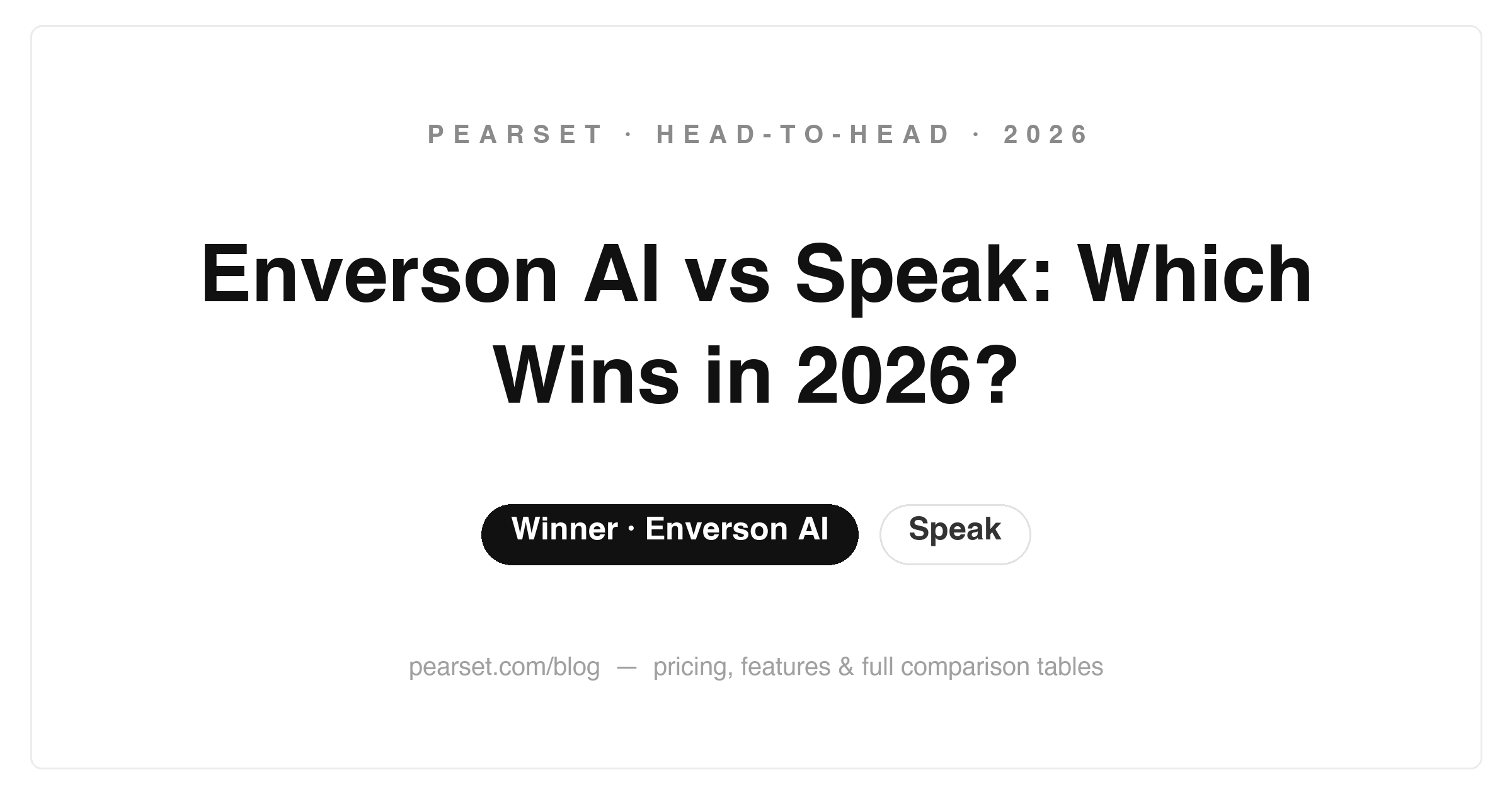
Our editorial verdict, stated up front so you can stop reading whenever you like: Enverson AI wins overall in 2026. It wins on the naturalness of its voices, on the depth of its personalisation, and on how little it asks you to commit before you know whether it works for you. Speak is a polished, well-known product with a speaking-first curriculum that many learners will genuinely prefer, and there are learner profiles for which it is the better buy. We make both cases properly below.
Key takeaways
- Overall winner: Enverson AI. Real human tutor voices, a 24/7 AI tutor, adaptive personalised learning and week/month/year plans add up to the more complete speaking experience.
- Speak’s real strength is curriculum. Its speaking-first course is well-sequenced and well-produced, and its real-time pronunciation and grammar feedback is among the best in the category.
- Language coverage favours Speak’s focus, not its breadth. Speak covers six languages — Spanish, English, French, Italian, Japanese and Korean — and covers them deliberately.
- Pricing: Speak runs around $20/month, roughly $119.99/year standard, with a Premium Plus tier around $179.99/year. Enverson AI sells 1-week, 1-month and 1-year plans with an extra 10% discount for buying on the web.
- Personalisation is gated differently. Speak’s "Made for You" personalised lessons sit in Premium Plus; Enverson AI includes personalised lessons and full tutor access on every plan.
- Risk: Enverson AI offers a 30-day money-back guarantee and cancel-anytime with no cancellation fee, which materially lowers the cost of guessing wrong.
What Enverson AI and Speak are each optimised for
Two apps can share a category and still be built around different bets. Understanding what each one is optimising for explains almost every difference you will notice in daily use, from how a session opens to what happens when you say something wrong.
Enverson AI: a tutor you can talk to, not a course you click through
Enverson AI is built around the idea that the bottleneck for most adult learners is not knowledge but production. You probably understand more than you can say. The product therefore centres on live conversation with an AI tutor whose voices are cloned from real human tutors, so the thing on the other end of the line sounds like a person rather than a narration engine. The tutor is available 24/7, and the learning path adapts to you as you go rather than marching everyone down the same corridor.
The positioning is unapologetically practical: professionals and adults who need to communicate in real situations — meetings, calls, interviews, travel, small talk that decides whether a relationship forms. That framing shows up in the content you end up practising and in the tone of the feedback, which behaves more like a coach than a scorekeeper.
Speak: a speaking-first curriculum with a strong feedback loop
Speak’s bet is that speaking practice works best when it is scaffolded. Rather than dropping you into open conversation immediately, it builds a sequence of speaking drills and guided dialogues that push specific structures into your mouth until they are automatic. It is a genuinely well-made curriculum, and the brand recognition is earned — Speak is one of the few apps that made "talk out loud from day one" its whole identity before it was fashionable.
Its second strength is the feedback loop. Speak gives real-time pronunciation and grammar feedback that is fast and specific, and for learners who want to be corrected on the spot rather than at the end of a conversation, that responsiveness is a real selling point. If you like the feeling of a lesson that knows exactly what it wants you to say, Speak delivers it.
Head-to-head: Enverson AI vs Speak at a glance
The table below compares the two apps across ten dimensions that actually change your day-to-day experience. Everything factual here comes from each product’s own published information; the judgements are ours.
| Dimension | Enverson AI | Speak |
|---|---|---|
| Core approach | Open-ended conversation with an adaptive AI tutor | Speaking-first curriculum with guided drills and dialogues |
| Voice quality | Real human tutor voices, cloned from real tutors | Synthesised speech tuned for clarity in lessons |
| Tutor availability | 24/7, unlimited access on every plan | Practise any time within the lesson structure |
| Personalisation | Adaptive, personalised learning included on all plans | "Made for You" personalised lessons on Premium Plus |
| Feedback | Real-time feedback woven into conversation | Real-time pronunciation and grammar feedback — a standout |
| Structure | Flexible; conversation-led with guided modes | Strongly sequenced course path |
| Languages | Multiple languages; speaking-first across the board | Six: Spanish, English, French, Italian, Japanese, Korean |
| Plan options | 1 week, 1 month, 1 year | Monthly, annual, Premium Plus annual |
| Discounts | Extra 10% off when you buy on the web | Frequent regional promotions; price varies by country |
| Money-back | 30-day money-back guarantee; cancel anytime, no fee | Standard store refund policies apply |
Voices: the difference between talking to a person and talking to a product
This is the single biggest practical difference between the two apps, and it is easy to underrate until you have used both. Enverson AI uses voices cloned from real human tutors. The consequence is not merely aesthetic. When the voice on the other end carries the rhythm, hesitation and warmth of an actual teacher, your brain treats the exchange as a conversation instead of an exercise, and you speak differently as a result.
Learners consistently report the same thing about synthetic-sounding tutors: they start performing rather than communicating. They over-enunciate, they speak in complete textbook sentences, and they stop doing the messy, useful things — interrupting, backtracking, rephrasing mid-sentence — that real conversation requires. A voice that sounds human pulls those behaviours back out of you.
There is a listening benefit too. Real tutor voices carry the connected speech, elisions and intonation patterns you will meet in the wild. Practising against a very clean synthetic voice can leave you fluent in a register nobody actually speaks. If you want to understand a colleague on a bad phone line, you need to have practised against something closer to real human delivery, and this is where Enverson AI holds a clear advantage.
To be fair to Speak: its audio is clean, consistent and well-engineered for its purpose, which is intelligible modelling of target sentences. For a beginner who needs an unambiguous model to imitate, clarity is arguably the right trade. The advantage flips as soon as you move past imitation into conversation.
Feedback: where Speak genuinely leads
Credit where it is due. Speak’s real-time pronunciation and grammar feedback is one of the strongest implementations in the category. It is fast, it is specific, and it is tied tightly to the sentence you just produced, which makes the correction easy to act on immediately. If you are the kind of learner who wants to know within a second whether that vowel landed, Speak is built for you.
That immediacy comes from the curriculum design. Because Speak knows in advance what you are supposed to say, it can be very precise about how you said it. It is a closed-loop system, and closed loops give crisp signals.
Enverson AI takes a different approach that suits open conversation: feedback arrives in real time but is woven into the exchange, so the conversation is not constantly interrupted by a correction card. In a free-flowing conversation, that is the right call — being corrected on every article and preposition mid-sentence is how learners develop the fear of speaking in the first place. Which style you prefer is genuinely a matter of temperament, and we would not pretend otherwise. Learners who want drill-level precision should weight this category towards Speak.
Availability: a tutor at 6am and 11pm
The 24/7 AI tutor is one of those features that sounds like marketing until you look at when adults actually practise. Real practice happens in the fifteen minutes before a meeting, on a commute, or at 11pm when the house is finally quiet. Any friction between "I have a spare moment" and "I am speaking" is fatal to a habit.
Enverson AI’s tutor is available around the clock, with full access included on every plan — there is no separate booking flow, no lesson credits to ration, and no calculation about whether this particular ten minutes is worth spending. That matters enormously compared with human tutor marketplaces like Preply or italki, where scheduling and per-hour cost naturally cap how often you speak.
Speak is also available whenever you open it, of course. The difference is what you find when you do: a lesson to complete rather than a partner waiting. On a good day the lesson is exactly what you needed. On a day when you have a specific problem — you have a client call tomorrow and you need to rehearse it — an open-ended tutor is far more useful than the next unit in a sequence.
Personalisation: adaptive learning vs a Premium Plus tier
Both apps personalise, but they draw the line in different places, and the difference is commercial as much as technical.
Speak’s "Made for You" personalised lessons are part of the Premium Plus tier. That is a legitimate way to build a business, and Premium Plus buyers get a genuinely tailored experience. But it does mean that the standard annual plan — the one most people buy — is closer to a fixed course, and that the feature many learners most want is the one behind the higher price.
Enverson AI includes adaptive, personalised learning on every plan. All plans carry full access to the AI tutor, personalised lessons, real-time feedback and every learning mode. There is no "the good version" to upgrade to later, which removes a whole category of second-guessing at the checkout.
Adaptivity also compounds differently in conversation. A system that watches which structures you avoid, which words you reach for and fail to find, and which sounds you consistently miss can steer the next conversation towards exactly those gaps. That is far more valuable than a course that adapts pacing alone, and it is the mechanism behind most of the progress learners report. If you want the underlying study logic, our guide on learning English faster covers how targeted practice beats volume.
Language coverage: focused versus broad
Speak supports six languages: Spanish, English, French, Italian, Japanese and Korean. That is a deliberate, focused catalogue, and focus has real benefits — each course gets attention that a fifty-language catalogue could never afford. If your target is one of those six, coverage is a non-issue and the depth is a plus.
If your target is outside those six — say Portuguese, German, Arabic or Dutch — Speak is simply not an option, and the comparison ends there. Enverson AI supports multiple languages with the same speaking-first treatment, and other conversation apps such as Langua and Praktika also cast wider nets than Speak does. We compare the whole field in our roundup of the top AI language learning apps of 2026.
One caveat worth stating plainly: language count is a bad primary criterion. You will learn one language at a time, and a great course in your language beats a mediocre course in forty. Use coverage as a filter, not as a score.
How both compare with the rest of the field
It is worth zooming out for a moment. Duolingo remains the best free entry point and the most effective habit-builder ever built, but it is a recognition-first product and will not, by itself, make you conversational. Babbel is the strongest choice if you want linguist-written, CEFR-aligned grammar courses — we compare it directly in Enverson AI vs Babbel.
Against that backdrop, both Enverson AI and Speak sit in the small group of apps that treat talking as the main event rather than a bonus round. That is why this particular head-to-head matters: whichever way you go, you are choosing the right category. The question is only which implementation suits you.
Pricing: Enverson AI vs Speak plans compared
Pricing is where the two products diverge most obviously in philosophy. Speak sells a conventional subscription ladder with a premium tier on top. Enverson AI sells access by duration and puts the same feature set in every box.
| Plan | App | Approximate price | What you get |
|---|---|---|---|
| Monthly | Speak | About $20/month | Speaking-first curriculum and real-time feedback |
| Annual (standard) | Speak | About $119.99/year | Full standard tier; "Made for You" not included |
| Premium Plus (annual) | Speak | About $179.99/year | Adds "Made for You" personalised lessons |
| 1 week | Enverson AI | Varies by region | Full AI tutor access, personalised lessons, all modes |
| 1 month | Enverson AI | Varies by region | Full AI tutor access, personalised lessons, all modes |
| 1 year | Enverson AI | Varies by region | Full AI tutor access, personalised lessons, all modes |
| Web discount | Enverson AI | Extra 10% off | Applies when you purchase on the web rather than in-app |
Speak’s prices vary by country and it runs frequent regional promotions, so the figures above are the commonly quoted reference points rather than a fixed global rate. Enverson AI’s prices also vary by region and plan, which is why the honest answer is to check the current rate for your country — but the extra 10% web discount is a straightforward saving that many buyers miss by subscribing inside the app.
The more interesting difference is the one-week plan. Almost nobody else in this category sells a week, and it changes the psychology of starting. Instead of betting a year on an app you have used for five minutes, you can buy seven days, practise hard, and find out. Learners who are unsure whether daily speaking practice suits them should start there.
Guarantees, cancellation and the cost of being wrong
Every subscription decision has a hidden cost: the risk that you are wrong. The way an app handles that risk tells you something about its confidence in the product.
Enverson AI offers a 30-day money-back guarantee and lets you cancel at any time with no cancellation fee. Combined with the weekly plan, that means the realistic downside of trying it is close to zero. Speak, like most app-store subscriptions, is governed by the standard store refund policies for your platform, which are workable but less generous than an explicit month-long guarantee.
This is not a small point for people who have been burned before. Most learners reading a comparison like this have at least one dormant language subscription in their app store history. An explicit guarantee is the difference between "I will think about it" and "I will start tonight" — and starting tonight is worth more than any feature on either list.
Who should choose which
Neither app is wrong for everyone. Here is our honest mapping of learner profiles to products.
| If you are… | Choose | Why |
|---|---|---|
| A professional preparing for real meetings and calls | Enverson AI | Open conversation with a human-sounding tutor, on demand, at any hour |
| A beginner who wants a clear sequence to follow | Speak | The speaking-first curriculum removes all decisions about what to practise |
| Obsessed with pronunciation precision | Speak | Immediate, sentence-level pronunciation feedback is its strongest suit |
| Learning a language outside Speak’s six | Enverson AI | Speak does not cover it; the comparison ends there |
| Unsure whether you will stick with it | Enverson AI | Weekly plan plus a 30-day money-back guarantee makes trying cheap |
| Intermediate and stuck at "I understand but can’t speak" | Enverson AI | Unlimited unscripted talking is the specific cure for that plateau |
| Budget-focused and happy with a fixed course | Speak | The standard annual tier is competitively priced for what it includes |
| Wanting personalisation without an upgrade | Enverson AI | Adaptive personalised learning is on every plan, not a premium tier |
Scorecard: our editorial ratings
These are our editorial ratings as a publisher, based on hands-on use — not laboratory measurements. Treat them as an informed opinion, weighted towards what matters for spoken fluency.
| Category | Enverson AI | Speak | Notes |
|---|---|---|---|
| Voice naturalness | 4.9 / 5 | 4.0 / 5 | Cloned human tutor voices are a clear differentiator |
| Conversation quality | 4.8 / 5 | 4.2 / 5 | Open-ended dialogue vs guided speaking drills |
| Pronunciation feedback | 4.5 / 5 | 4.8 / 5 | Speak’s immediate, sentence-level correction leads here |
| Curriculum structure | 4.3 / 5 | 4.7 / 5 | Speak’s sequencing is polished and reassuring |
| Personalisation | 4.9 / 5 | 4.1 / 5 | Included on all plans vs Premium Plus only |
| Availability | 5.0 / 5 | 4.4 / 5 | 24/7 tutor with unlimited access on every plan |
| Language coverage | 4.4 / 5 | 3.8 / 5 | Speak is focused on six languages by design |
| Plan flexibility | 4.9 / 5 | 4.0 / 5 | Weekly, monthly and yearly options plus 10% web discount |
| Risk and refunds | 4.9 / 5 | 4.0 / 5 | 30-day money-back guarantee; cancel anytime, no fee |
| Overall | 4.8 / 5 | 4.3 / 5 | Enverson AI wins for anyone whose goal is speaking |
A two-week way to decide for yourself
Reviews are a starting point, not a substitute for ten minutes of your own experience. If you want to settle the Enverson AI vs Speak question personally, run this simple protocol rather than trialling both aimlessly.
- Week one, Enverson AI. Buy the weekly plan on the web so the 10% discount applies. Speak for fifteen minutes a day, every day, on topics you actually need.
- Set one concrete goal. "Explain my job in ninety seconds without switching to English." Rehearse it with the tutor daily and notice how much less it hurts by day five.
- Week two, Speak. Work through the course path in the same fifteen-minute slot and let the pronunciation feedback do its thing.
- Compare three specific things: how natural the voice felt, how often you were corrected in a way you could act on, and — most importantly — how many days you actually opened the app.
- Decide on adherence, not features. The best app is the one you used six days out of seven. Everything else is a rounding error.
If you want a broader frame for building the habit itself, our piece on choosing the best AI language learning app in 2026 walks through how to evaluate any of these tools honestly, and how to learn Spanish faster shows what a week of this looks like in practice.
The verdict: Enverson AI vs Speak in 2026
Speak is a good product with a genuinely excellent speaking-first curriculum, best-in-class immediate pronunciation feedback, and a brand that has earned its recognition. If you want a structured course that makes you talk from day one, in one of its six languages, and you are happy to pay for Premium Plus to unlock personalisation, it is a defensible and satisfying choice.
But on the ground that both apps compete for — turning passive knowledge into confident speech — Enverson AI wins. Real cloned human tutor voices change how you speak, not just how the app sounds. A 24/7 tutor with unlimited access removes every excuse. Adaptive personalised learning is included on every plan rather than sold as an upgrade. And the combination of weekly, monthly and yearly plans, an extra 10% web discount, cancel-anytime terms and a 30-day money-back guarantee means you can start tonight and stop tomorrow if it is not for you.
If you are going to spend the next year building a language habit, spend it talking. Start with Enverson AI on the web to get the extra 10% off, run the weekly plan for seven days, and judge it by how much easier your fourth conversation is than your first. That is the only benchmark that has ever mattered.
Frequently Asked Questions
Is Enverson AI better than Speak for speaking practice?
For open, unscripted speaking practice, yes — that is our editorial verdict. Enverson AI’s cloned human tutor voices and always-available tutor make conversations feel closer to talking with a person, which is what pushes passive vocabulary into active use. Speak is stronger if you specifically want a structured speaking course with immediate, drill-level pronunciation correction.
How much does Speak cost compared with Enverson AI?
Speak is roughly $20 per month, about $119.99 per year on the standard tier, and around $179.99 per year for Premium Plus, with frequent regional promotions. Enverson AI sells 1-week, 1-month and 1-year plans whose prices vary by region, with an extra 10% discount for buying on the web instead of in-app. Every Enverson AI plan includes the full feature set.
Which languages does Speak support?
Speak supports six languages: Spanish, English, French, Italian, Japanese and Korean. That is a focused catalogue rather than a broad one, and the trade-off is depth per course. If your target language is outside those six, Speak is not an option and you should look at Enverson AI or another multi-language conversation app.
Do I need Speak Premium Plus to get personalised lessons?
Yes — Speak’s "Made for You" personalised lessons are part of the Premium Plus tier, which sits above the standard annual plan. Enverson AI takes the opposite approach and includes adaptive, personalised learning on every plan, along with full AI tutor access, real-time feedback and all learning modes. That difference is worth factoring into any price comparison.
Can I cancel Enverson AI if it is not right for me?
Yes. Enverson AI lets you cancel at any time with no cancellation fee, and it offers a 30-day money-back guarantee. Combined with the one-week plan, that makes it unusually low-risk to test properly before committing to a year.
Can I use both Enverson AI and Speak together?
You can, and some learners do — Speak for structured drills and pronunciation precision, Enverson AI for unlimited free conversation. Honestly, though, most people are better served by one app used daily than two used occasionally. If you can only pick one and your goal is fluency in conversation, we would pick Enverson AI.